

Think about how you searched for something the last time you needed a recommendation. Maybe you typed a question into Google and read the AI-generated summary at the top. Maybe you asked ChatGPT, Gemini, or Perplexity and got a direct answer without opening a single website.
Your customers are doing the same thing. That shift is the biggest change to search in more than a decade.
At The Marketing Mingle, we work with brands every day on visibility, content, and growth. Here is what AI search means for your business in 2026 and what you can do about it.
What Is AI Search, and Why Does It Matter?
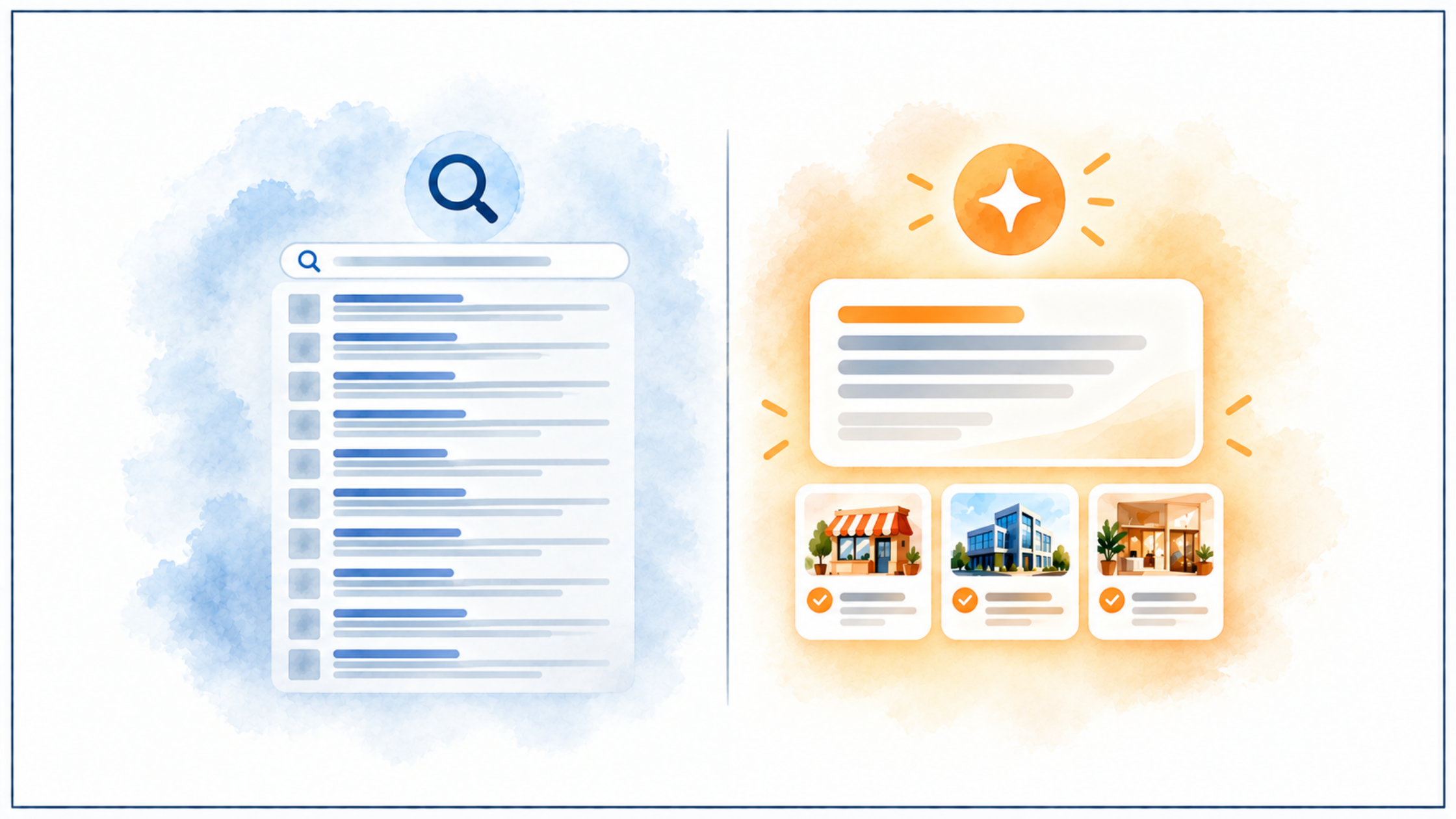
Traditional search gave you a list of blue links, and you chose which to click. AI search works differently. Tools like Google’s AI Overviews and AI Mode, ChatGPT, Gemini, and Perplexity read information from across the web and write a single, conversational answer.
For users, this is faster and more convenient. For businesses, it changes how customers discover you:
- Answers come before clicks. Many searchers get what they need without visiting a website.
- Queries are longer and more natural. People now ask full questions, such as “Which digital marketing agency is best for a small startup with a tight budget?”
- Fewer brands get mentioned. An AI answer might recommend three or four businesses, where a results page listed ten.
So the goal is no longer just to rank. You need to be cited, mentioned, and trusted by the AI itself.

Is SEO Dead? Not Even Close.
Every few years someone declares SEO dead, and every time they are wrong. SEO is evolving, not disappearing.
AI search engines still depend on the open web to learn and find answers. They pull from websites that are well structured, credible, and useful, which is exactly what good SEO has always been about. The fundamentals still matter: technical health, quality content, and authority. What has changed is how we apply them.
You will also hear new terms:
- GEO (Generative Engine Optimization): Optimizing your content so AI tools can find, understand, and reference it in generated answers.
- AEO (Answer Engine Optimization): Structuring content to give clear, direct answers to the questions people ask.
Think of these as the next layer of SEO. They build on what you already do rather than replace it.
6 Ways to Adapt Your SEO Strategy for AI Search in 2026
1. Write for real questions, not just keywords
Keyword lists are still useful, but AI search rewards content that answers full questions. Start with the real questions your customers ask on sales calls, in DMs, and in reviews. Then build pages and blog posts that answer them clearly and completely.
Tip: Put a concise, direct answer near the top of the page, then expand with detail, examples, and context. AI tools find it easy to pull answers from content that is organized this way.
2. Build genuine expertise (E-E-A-T matters more than ever)
AI systems are designed to avoid unreliable information, so they favor sources that show Experience, Expertise, Authoritativeness, and Trustworthiness. Generic, mass-produced content will not stand out, because AI can produce that in seconds.
What stands out is what only you can offer:
- Original insights from your own work
- Case studies and real results
- Named authors with real credentials
- Honest opinions and a clear point of view
3. Get your technical foundation right
Even the best content is useless if search engines and AI crawlers cannot read it. Make sure your website has:
- Fast loading speeds and a mobile-friendly design
- A clean structure with clear headings and logical internal links
- Schema markup (structured data) that tells machines what your content is about
- No crawling or indexing errors
4. Build your brand beyond your website
AI tools learn about businesses from many sources, not only their own sites. Reviews, press mentions, directory listings, social profiles, podcasts, and guest articles all shape how an AI understands your brand.
Keep your business information consistent everywhere, keep your Google Business Profile up to date, and earn mentions on reputable platforms in your industry. In AI search, being talked about is as valuable as being linked to.
5. Use multiple content formats
People search in many ways now, including text, voice, images, and video. Repurpose your best ideas into short videos, infographics, FAQs, and podcasts. This helps you reach people wherever they search, and it gives AI more material to work with.
6. Measure what matters now
Rankings and organic traffic are still important, but they no longer tell the full story. In 2026, also track:
- Brand visibility in AI answers: Are you being mentioned when people ask AI tools about your industry?
- Branded search growth: Are more people searching for your business by name?
- Lead quality and conversions: Fewer visitors who are more ready to buy can be better than lots of casual clicks.
What This Means for Small and Growing Businesses
You might think AI search favors big brands with huge budgets. In reality, it can open a door for smaller businesses. AI tools care about relevance and usefulness, not just size. A focused business that publishes clear, helpful, expert content in its niche can earn visibility that would once have taken years of link building.
The businesses at risk are those that do nothing, carrying on with outdated tactics while their customers move to new ways of searching.
Where to Start: Your First 30 Days
You do not need a full rebuild. Here is a simple 30-day plan any business can follow, whether you have a team of one or twenty.
A quick win for today: open ChatGPT, Gemini, Perplexity and Google AI Mode, and ask each one the question your ideal customer would ask right before hiring you. Note whether you are mentioned, who is, and which websites are cited. That five-minute test shows you exactly where you stand.
Week 1: Find out where you stand
- Write down 10 real questions customers ask you, taken from sales calls, WhatsApp chats, emails and reviews.
- Run each question through the four AI tools and record the results in a simple sheet: brand mentioned or not, competitors named, sources cited.
- Open Google Search Console and list the pages that already bring impressions and leads. These are your priority pages.
Week 2: Fix your five most important pages
- Add a clear, two-to-three sentence answer at the top of each page, followed by the detail.
- Add a short FAQ section to each page using the exact questions from Week 1.
- Add schema markup (Organization, Article, LocalBusiness or Service, depending on the page) and check it with Google’s Rich Results Test.
- Check that your robots.txt file and security settings are not accidentally blocking search or AI crawlers.
Week 3: Build proof that AI can trust
- Add real author bios with credentials to your blog posts and service pages.
- Publish one detailed case study with actual numbers, such as leads generated, cost per lead or growth in traffic.
- Update your Google Business Profile, and ask five recent customers for reviews that mention the service and the city.
- Pick three industry directories, publications or podcasts where your brand should be listed or featured, and start pitching.
Week 4: Publish and set up tracking
- Publish four question-led articles that answer the top gaps you found in Week 1.
- In GA4, check referral traffic from sources such as chatgpt.com and perplexity.ai.
- Repeat your 10-question AI test at the end of the month and compare it with Week 1.
- Track branded searches in Search Console to see whether more people are looking for you by name.
Repeat the test every month. AI answers change often, so treat this as a habit rather than a one-time project.

Final Thoughts
AI is changing how people search, but the principle behind SEO is the same as ever: be the most helpful, trustworthy answer to your customer’s question. The businesses that adapt early will gain a real advantage as AI search keeps growing through 2026 and beyond.
Ready to Future-Proof Your SEO?
At The Marketing Mingle, we help brands stay visible in both traditional and AI-powered search, with strategy, content, and technical SEO built for where search is going. Whether you want a full audit or just a starting point, we’d love to talk.
Get in touch with The Marketing Mingle today and let’s make your brand impossible for AI, and your customers, to ignore.
Read Similar Stories